

Memories can be hazy. Sometimes they fade altogether. Over time, however, fact often blurs into fiction.
In researching the diminishing landscape of America’s arcades, we often uncover the names of long-forgotten arcades that once dotted the country. However, other than one solitary mention in a newspaper article about licensing fees or an ordinance dispute, there’s no other record of when they opened or when they vanished.
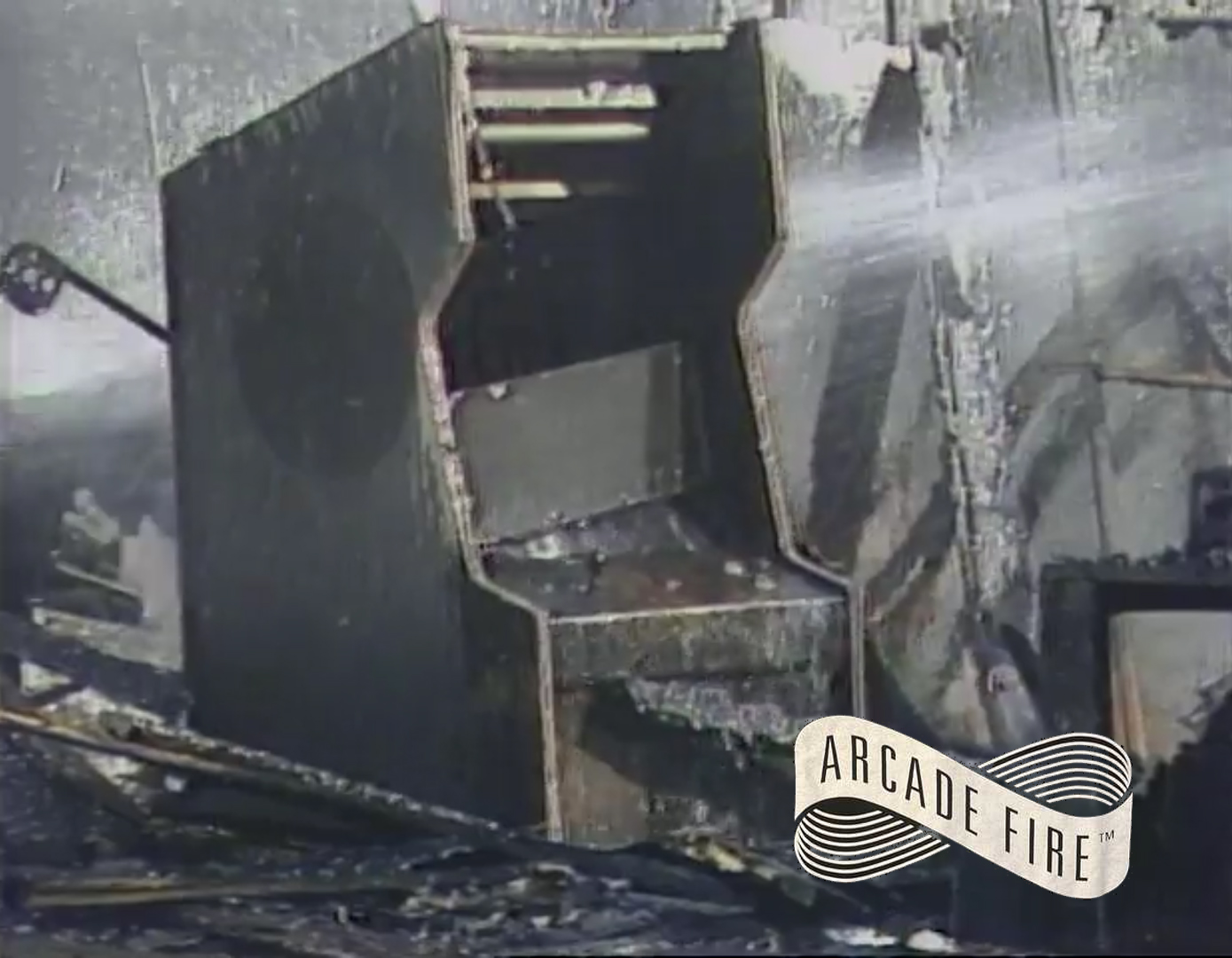
That’s why when I discovered B-roll video footage of smoldering arcade cabinets in my search I was so intrigued to uncover the story, but I never expected to learn these charred ruins might somehow be connected to the Grammy Award-winning Canadian Indie rock band, Arcade Fire.
The text pre-empting the grainy ’80s video footage labels it “Evans St Fire” and gives the date “Saturday 1/5/85.” A quick online search pulls up absolutely zero results, but knowing a specific date and that the footage comes from KXAS-TV in Ft. Worth, Texas I know I’ll need to dive into the trusty online newspaper database, newspapers.com to see what I can find. In the meantime, my various search engine queries about an arcade fire in 1985 in Texas invariably lead me to results of the band of the same name, notably:
“The phrase ‘arcade fire’ famously originates from a childhood story told to the band’s frontman, Win Butler, who grew up in the suburbs of Houston, Texas.”
and
“While a popular myth suggests the band’s name refers to a tragic, literal fire at a video arcade in 1985 that killed several children, Butler has clarified that it was actually a fictional story a bully or local kid told him when he was young, which he initially believed to be true.”
Despite these morsels of intrigue, I still couldn’t find any specific instance of a 1985 fire on Evans Street in Texas. That is, however, until I expanded my search to Evans AVENUE and bingo!
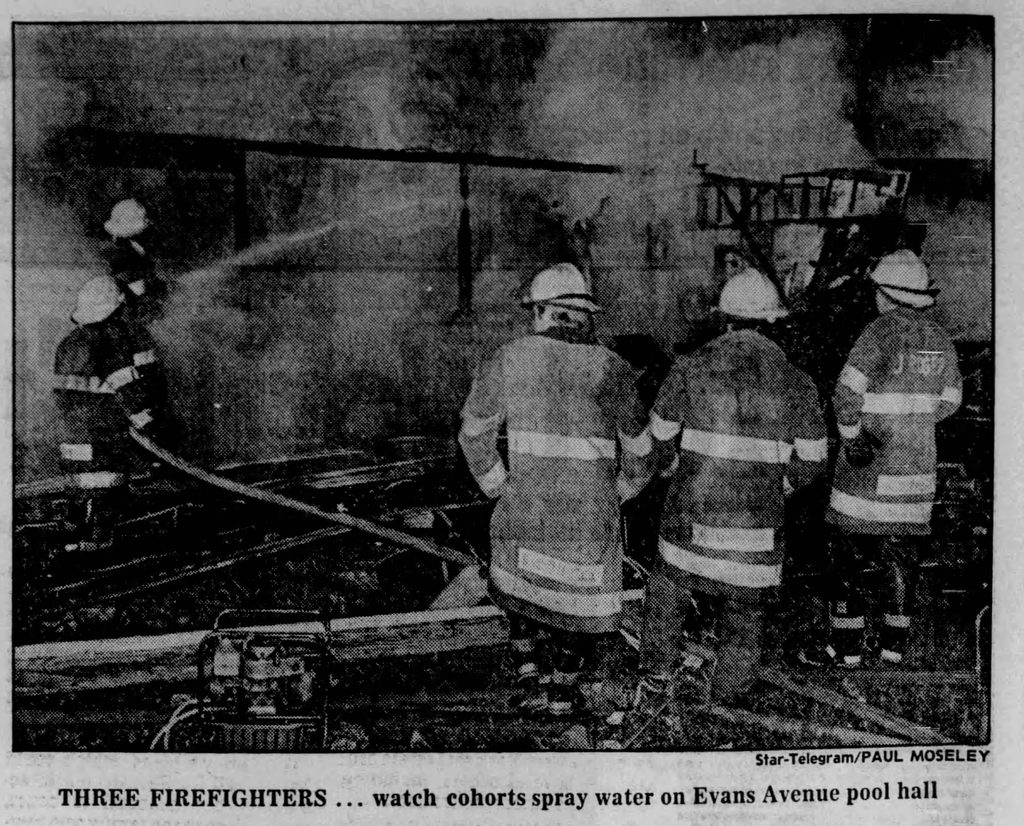
Photo: Fort Worth Star Telegram · Source: newspapers.com
“Fort Worth firefighter injured when trapped by falling wall” the headline reads. What I learned was actually page 2 of a front-page article titled “Firefighter is battling for his life six others injured in pool hall blaze” would also reveal the name of the establishment: Tommy’s Recreations at 1305 Evans Ave.
50 firefighters were sent to a 6AM blaze more than likely caused by arson in an attempt to cover up a burglary. The “highly suspicious” incident included an open back door spotted by a witness, doors removed from their hinges, and pry bar marks on at least one cigarette machine. Investigators estimated the damage to be at least $100,000, but the human cost was much worse.
Acting Lieutenant Robert L. Keen, a 19-year veteran, would become trapped under a wall when the roof collapsed and forced the walls outward. Buried for five minutes before rescuers could access him using hydraulic rescue tools, Lt. Keen would be taken to the hospital in critical condition where he would stay for another week before being removed from life support. He died aged 48. No one was ever charged.
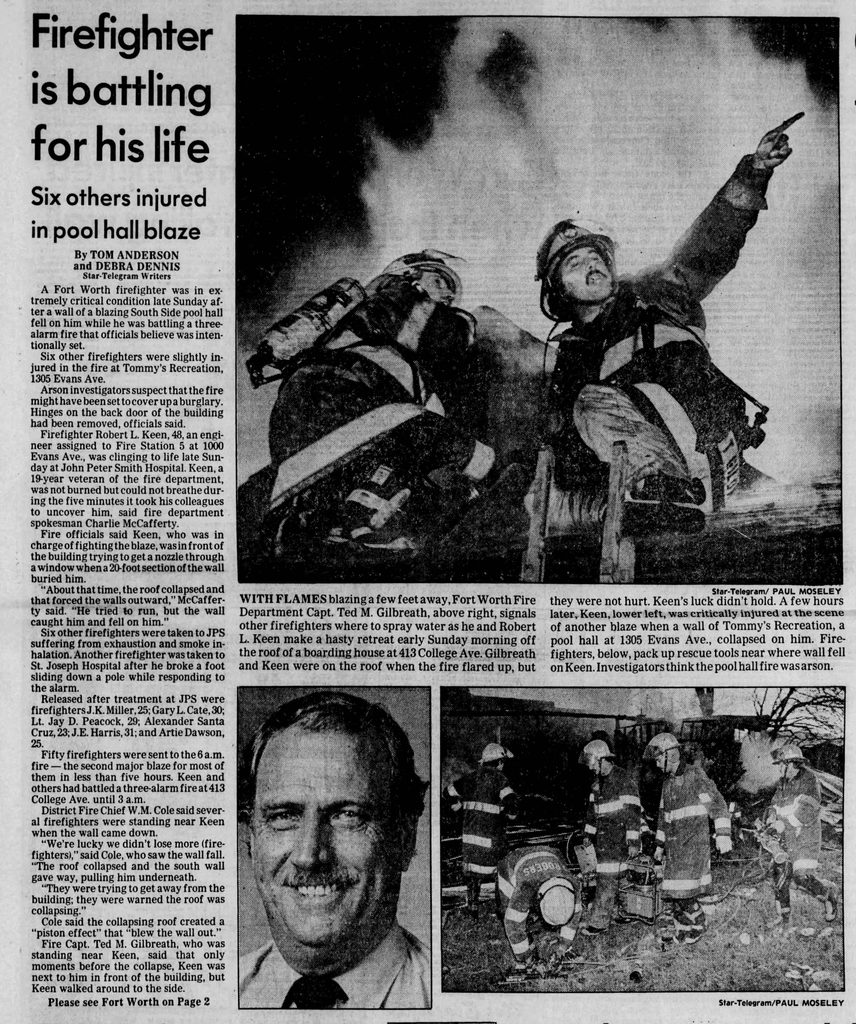
Photo: Fort Worth Star Telegraph · Source: newspapers.com
Seeing the footage that probably played on the nightly news in Texas in 1985, it’s not a hard leap to see how this tragic incident with visuals of charred, smoldering arcade cabinets might have become lore.
Arcade Fire’s lead singer, Win Butler, would have been around 5 years old in 1985, living in Texas. Granted, Butler lived in Houston, not Ft. Worth, but if he or other local kids saw that exact KXAS-TV broadcast—or heard parents talking about a local arcade “burning to the ground”—it is highly likely that this real news event became the foundation for the ghost story told to him by older neighborhood kids. TV news images extend into imagination. Over the years, the real-world fire mutated into the classic playground myth that “children died inside,” a common trope added to local tragedies by kids.
When asked about the rumor that the band’s name refers to a fire in an arcade, Win Butler replied:
“It’s not a rumor, it’s based on a story that someone told me. It’s not an actual event, but one that I took to be real. I would say that it’s probably something that the kid made up, but at the time I believed him.”
Nothing was ever rebuilt and the address remains nothing more than a vacant lot. Unless you have memories personally stepping foot into Tommy’s Recreation in Fort Worth, Texas, then it’s unlikely we’ll ever know much more about it as seemingly no other documentation exists. Could this be the arcade fire that actually inspired the name “Arcade Fire?” We may never fully know, but it’s more believable than ever.